
 Radalt White Paper
 The Missing Middle
Democratizing IFC Workflows for Every BIM Professional
The IFC file format is the backbone of openBIM — yet the tools to work with it are either prohibitively expensive or require programming knowledge. Enterprise platforms such as Solibri Office (US$ 1,000+ per year) and SimpleBIM (US$ 1,000+ per year) are out of reach for freelancers, small firms, and students. IfcOpenShell is free but has no graphical interface or 3D viewer.
Radalt Toolkit fills this gap. It delivers IFC slicing, merging, clash detection, IDS compliance checking, version comparison, and property editing — through a modern desktop interface with an integrated 3D viewer — for free.
1. Introduction
Building Information Modelling (BIM) has transformed how the architecture, engineering, and construction (AEC) industry designs, constructs, and manages buildings. At the heart of BIM interoperability is the IFC standard — an open, vendor-neutral file format developed by buildingSMART International and ratified as ISO 16739.
IFC enables architects, engineers, contractors, and facility managers to exchange rich building data regardless of which authoring software they use. Autodesk Revit, Graphisoft Archicad, Trimble Tekla, and dozens of other tools can all export and import IFC — in theory enabling seamless collaboration.
In practice, however, working with IFC files beyond simply viewing them requires specialist software. Professionals need to validate models against quality standards, detect geometry clashes, compare model versions, extract and edit properties, and merge files from different disciplines. These are everyday tasks in a BIM workflow — and the tools to perform them are either locked behind expensive enterprise licenses or accessible only to those who can write code.
This white paper examines the current state of IFC tooling, identifies the gap, and presents Radalt Toolkit as the solution.
2. The IFC Ecosystem and Its Stakeholders
2.1 What Is IFC?
IFC (Industry Foundation Classes) is an open data schema for describing building and infrastructure assets. It encodes not just geometry but semantic data — the type of element, its properties, relationships, and metadata. An IFC file can describe a building's structural frame, its MEP systems, fire safety classifications, energy performance data, and more.
The format is maintained by buildingSMART International and is the foundation of openBIM. ISO 16739-1:2018 defines the current standard (IFC4), with IFC4.3 extending coverage to infrastructure projects.
2.2 Who Uses IFC Files?
IFC stakeholders span the entire project lifecycle:
- Architects and designers — export IFC from authoring tools for coordination
- Structural and MEP engineers — receive architectural IFC and federate with their own models
- BIM coordinators — quality-check models, detect clashes, and enforce standards
- Contractors — receive federated models for construction planning and sequencing
- Facility managers — receive as-built IFC models for asset management
- Students and academics — learn BIM workflows and conduct research
- Software developers — build integrations and validation pipelines
3. The Problem: A Market Gap in IFC Tooling
3.1 The Enterprise Tier: Powerful but Expensive
Two tools dominate the specialist IFC workflow market:
A model checking and quality assurance platform with comprehensive IFC support. Offers rule-based validation, clash detection, version comparison, and a 3D viewer. Widely used in Scandinavian and European BIM workflows.
US$ 1,000+ per year
Provides IFC data manipulation, property editing, model merging, clash detection, and a full 3D viewer. Known for its IFC-native approach and strong property management capabilities.
US$ 1,000+ per year
Both platforms are functionally mature. However, at these price points, they are realistic only for larger organisations with dedicated BIM budgets. A freelance BIM coordinator, a small architecture practice, or a university student cannot reasonably absorb US$ 1,000+ per year for software they may use only periodically.
3.2 The Open-Source Tier: Capable but Inaccessible
IfcOpenShell is the leading open-source IFC library, written in Python and C++. It provides programmatic access to virtually every IFC operation — yet using it requires:
- Installing Python and managing dependencies
- Writing scripts to perform each operation
- Understanding IFC schema concepts at a technical level
- Parsing and interpreting raw JSON or Python object output
There is no graphical interface, no 3D viewer, and no workflow automation.
3.3 The Viewer Tier: Visual but Passive
Free IFC viewers — BIMvision, xBIM WeXplorer, Autodesk's online viewer — allow navigation and inspection of IFC models but offer no capability to process, validate, edit, or export data.
3.4 Summary of the Gap
| Capability | Enterprise Tools | IfcOpenShell | IFC Viewers |
|---|---|---|---|
| 3D Viewer | Yes | No | Yes |
| No-code UI | Yes | No | Yes |
| Full IFC workflow features | Yes | Scripted only | No |
| Accessible pricing | No | Free | Free / Low |
The intersection — full features, 3D viewer, no-code UI, accessible pricing — is empty. This is the gap Radalt Toolkit fills.
4. Radalt Toolkit: Bridging the Gap
4.1 Overview
Radalt Toolkit is a free desktop application that brings the full power of IfcOpenShell to non-technical users through a modern graphical interface with an integrated 3D viewer. It runs on Windows as a native desktop application, with no cloud dependency for core operations.
4.2 Core Features
IFC Slicer
Filter and extract subsets of an IFC model by spatial structure, element type, or property values. Visualise the selection in 3D before exporting.

IFC Merge
Combine multiple IFC files from different disciplines or design stages into a single federated model. Handles GlobalId conflicts and preserves spatial hierarchy.

Clash Detection
Detect geometric intersections between elements across one or more IFC models. IfcOpeningElement false positives (window and door openings in host walls) are automatically filtered.

IDS Compliance Checking
Validate an IFC model against an Information Delivery Specification (IDS) — the buildingSMART standard for defining what data a model must contain. Results are shown per requirement with pass/fail status and element-level detail.
Version Comparison
Compare two versions of an IFC model to identify added, deleted, and modified elements. Changes are highlighted in the 3D viewer.

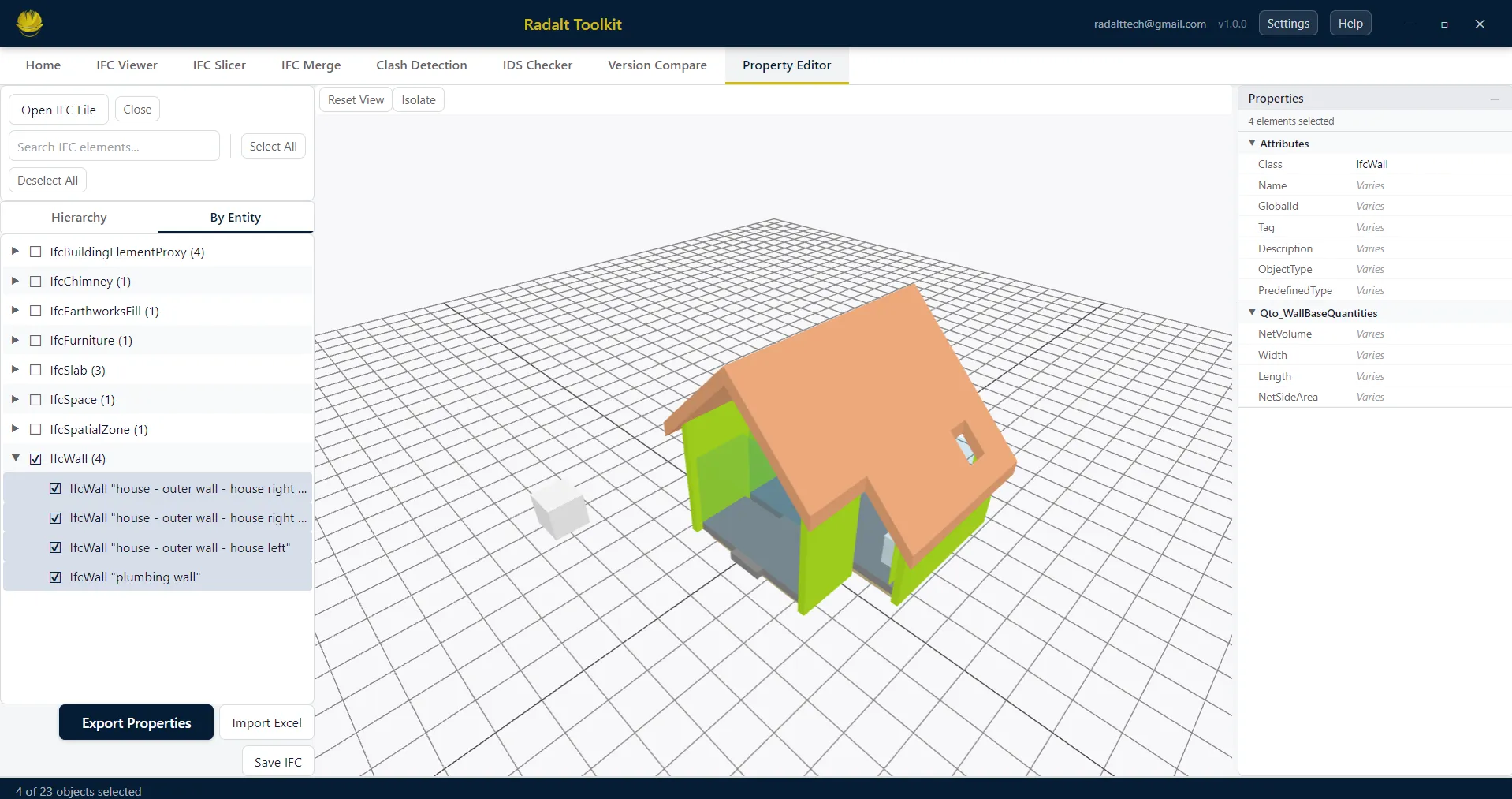
Property Editor
Browse and edit IFC element properties directly, with support for CSV export and import. Enables bulk property updates without returning to the authoring software.
4.3 Technical Foundation
- IfcOpenShell — IFC parsing, geometry, and all analytical operations
- Electron — cross-platform desktop runtime
- ifcdiff, ifcclash, ifctester, ifcpatch, ifccsv — specialist IfcOpenShell libraries for each workflow
4.4 Pricing
No per-user fees, no annual subscriptions, no feature tiers. The full application is available to individuals, small firms, and large organisations alike at no cost.
5. Feature Comparison
| Feature | Radalt Toolkit | Solibri Office | SimpleBIM | IfcOpenShell |
|---|---|---|---|---|
| 3D Viewer | Yes | Yes | Yes | No |
| No-code graphical UI | Yes | Yes | Yes | No |
| Clash Detection | Yes | Yes | Yes | Scripted |
| IDS Compliance Checking | Yes | Yes | Yes | Scripted |
| Version Comparison | Yes | Yes | Yes | Scripted |
| Property Editing | Yes | Yes | Yes | Scripted |
| IFC Merge / Slice | Yes | Yes | Yes | Scripted |
| Price | Free | US$ 1,000+ / yr | US$ 1,000+ / yr | Free (no UI) |
6. Use Cases
6.1 Freelance BIM Coordinator — Model Quality Before Handover
A freelance BIM coordinator receives IFC files from three subcontractors and needs to check for clashes, verify IDS compliance, and compare against last month's models. With Radalt Toolkit, she performs all three tasks through a GUI in under an hour — at no cost.
6.2 Small Architecture Practice — Discipline Coordination
A five-person practice needs to federate models, detect clashes, and track design changes. Enterprise licenses for five users would cost US$ 5,000+ per year. Radalt Toolkit provides the same core workflows for free, across all users.
6.3 University Student — BIM Education
A postgraduate student needs to validate a model against IDS, compare design iterations, and extract property data. Radalt Toolkit requires neither a budget nor a Python environment — just a Windows machine.
6.4 Facility Manager — As-Built Model Management
A facility manager needs to verify asset data and compare the final model against the previous stage submission. Radalt Toolkit gives direct access to IFC data without specialist software procurement or IT support.
7. The Broader Significance: OpenBIM in Practice
The openBIM movement depends on IFC being practically usable by all project participants — not just those with enterprise software budgets. When critical IFC workflows are accessible only to well-funded organisations, the promise of openBIM is partially undermined. Data quality suffers when smaller participants cannot validate their models. IDS adoption is slowed when validation tools are out of reach.
Radalt Toolkit is a practical contribution to openBIM adoption. By removing the cost barrier without sacrificing capability or usability, it extends IFC workflows to the full breadth of the AEC community.
8. Conclusion
The IFC tooling landscape has a clear and well-defined gap: there is no free, fully-featured, graphical, 3D-enabled application for end-user IFC workflows. Enterprise tools are capable but expensive. IfcOpenShell is powerful but requires programming. Viewers are accessible but passive.
Radalt Toolkit closes this gap — delivering the full IFC workflow suite within a modern desktop interface and integrated 3D viewer, at no cost. For the freelancer, the small firm, the student, and the facility manager, Radalt Toolkit is the IFC tool the industry has been missing.
By downloading, you agree to the End User Licence Agreement.
References
- buildingSMART International. IFC — Industry Foundation Classes. buildingsmart.org
- ISO 16739-1:2018. Industry Foundation Classes (IFC) for data sharing in the construction and facility management industries.
- Solibri Office. Pricing & Plans. solibri.com/pricing
- Simplebim. Purchase Simplebim online. simplebim.com/buy
- IfcOpenShell. Open source IFC library and tools. ifcopenshell.org
- buildingSMART International. Information Delivery Specification (IDS). buildingsmart.org
For enquiries: [email protected]